

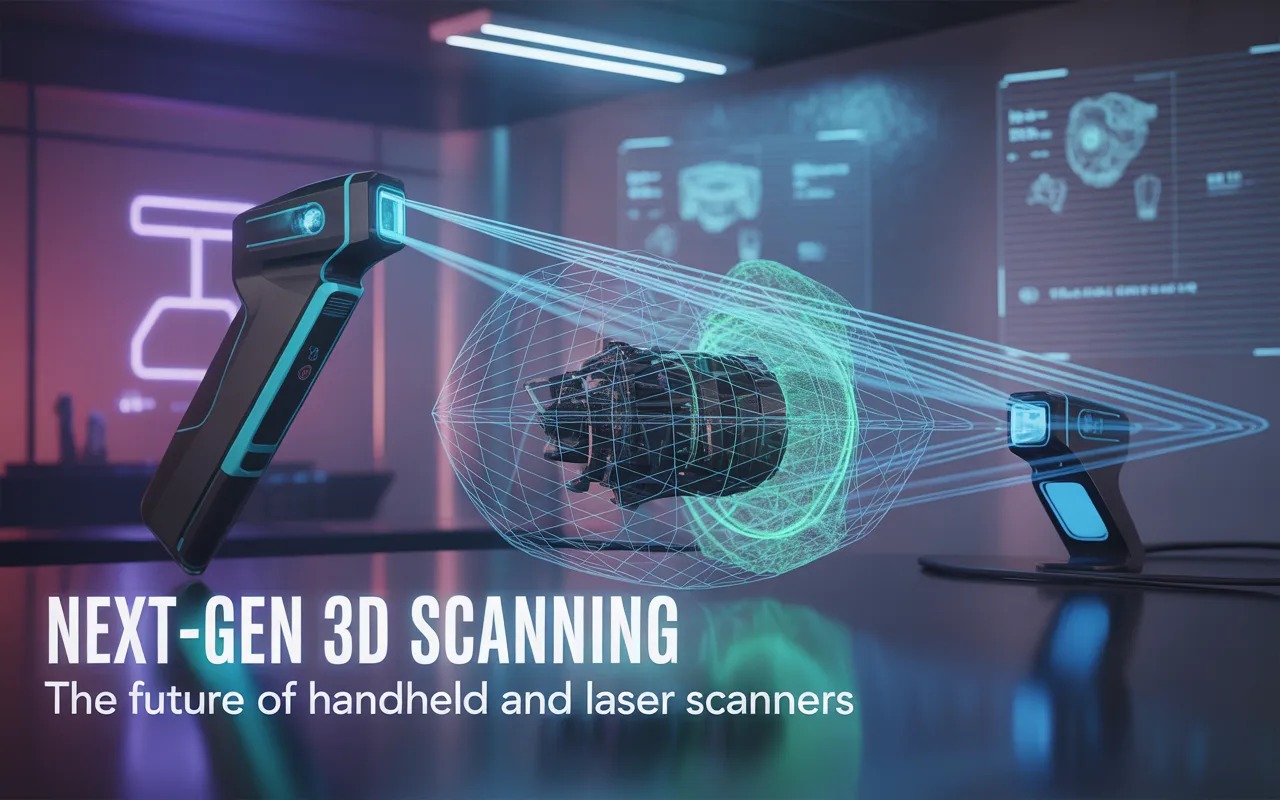
3D scanning has come a long way in recent years. What was once limited to large industrial setups is now more accessible, accurate, and versatile than ever before. The rise of next-generation 3D scanners is transforming how designers, engineers, and makers capture the real world digitally.
These advanced scanners are faster, more precise, and easier to use, allowing anyone to create detailed digital models for prototyping, 3D printing, reverse engineering, and more.
Understanding Next-Generation 3D Scanners
At its core, a next-generation 3D scanner captures the shape, dimensions, and surface details of physical objects. Unlike earlier models, these scanners combine high accuracy with portability and intelligent software, making them suitable for both professional and personal use.
Modern scanners include features like real-time tracking, advanced point-cloud generation, and easy integration with CAD or 3D printing workflows. They eliminate much of the guesswork in traditional modeling, allowing creators to work faster and more efficiently.
Handheld and Laser 3D Scanners: What’s the Difference?
Handheld 3D scanners are portable, flexible, and ideal for scanning objects of various sizes and shapes. They allow users to move around the object, capturing complex surfaces that stationary scanners may miss.
Laser 3D scanners, on the other hand, offer high-precision scanning using laser beams to measure every contour of an object. They are perfect for detailed work, capturing intricate designs, and ensuring measurements are exact.
Many modern devices combine both technologies, offering the precision of laser scanning with the mobility of handheld units.
Benefits of Next-Generation 3D Scanners
The next-generation 3D scanners bring several advantages to studios, workshops, and industrial environments:
- Accuracy: Captures even the finest details, reducing errors in prototypes or final products.
- Speed: Faster scanning and data processing shorten project timelines.
- Portability: Lightweight designs allow scanning on-site, in workshops, or studios.
- Ease of Use: Intuitive software makes capturing, editing, and exporting models straightforward.
- Versatility: Works with small intricate parts as well as larger objects.
These benefits make handheld and laser scanners indispensable tools for professionals and makers alike.
Applications Across Industries
Handheld and laser 3D scanners are no longer just for large factories. Their applications span multiple industries:
- Product Design: Scan prototypes and refine digital models quickly.
- Engineering: Reverse-engineer parts and inspect components for quality control.
- Art and Cultural Preservation: Digitize sculptures, artifacts, and historical items.
- Medical and Prosthetics: Capture precise anatomical models for custom devices.
- Education: Teach students about digital modeling, 3D printing, and modern scanning technology.
The flexibility and accuracy of next-gen scanners allow these industries to innovate faster and with more confidence.
Why Revopoint Leads in Next-Gen Scanning
Revopoint is at the forefront of next-generation 3D scanners, offering handheld and laser 3D scanners that combine precision, portability, and user-friendly software. Their solutions are designed to meet the needs of professionals, makers, and educators.
Key features include:
- High-resolution scanning for capturing intricate details
- Real-time tracking to reduce rescans and errors
- Lightweight, handheld designs for mobility and convenience
- Software integration for editing, exporting, and 3D printing workflows
- Versatility for objects of all shapes and sizes
With these capabilities, Revopoint’s scanners make advanced 3D scanning accessible without sacrificing quality or performance.
How to Get the Most Out of Your Scanner
Even with the best handheld and laser 3D scanners, workflow matters. Consider these tips:
- Proper lighting: Ensures accurate scans and reduces noise in the data.
- Stabilize objects: Keeps models precise, especially for detailed work.
- Capture multiple angles: Ensures complete coverage of the object.
- Edit and refine scans: Use software to align, clean, and optimize models before exporting.
Following these steps maximizes the potential of next-generation scanners and ensures high-quality results for any project.
The Future of 3D Scanning
The future of 3D scanning is bright. Next-generation 3D scanners are expected to become even faster, smarter, and more intuitive. AI-assisted tracking, higher-resolution sensors, and seamless software integration will make capturing objects easier than ever.
For studios, workshops, and professionals, this means shorter project timelines, more accurate prototypes, and greater creative freedom. Handheld and laser scanning will continue to play a crucial role in innovation, design, and production.
Final Thoughts
Next-generation 3D scanners are redefining how we capture, design, and produce. By combining the portability of handheld devices with the precision of laser scanning, creators and professionals can work more efficiently and accurately than ever before.
With handheld and laser 3D scanners from Revopoint, anyone can integrate advanced scanning technology into their workflow, creating precise digital models ready for prototyping, 3D printing, or production.
For designers, engineers, and makers looking to stay ahead, adopting next-gen scanning technology is no longer optional—it’s the key to faster, smarter, and more accurate workflows.
 Hamza
Hamza  Blitz
Blitz