
 admin
admin  Blitz
Blitz  Backlinks Hub
 Coomer.su: Is It Safe, Legal & Still Working in 2026?
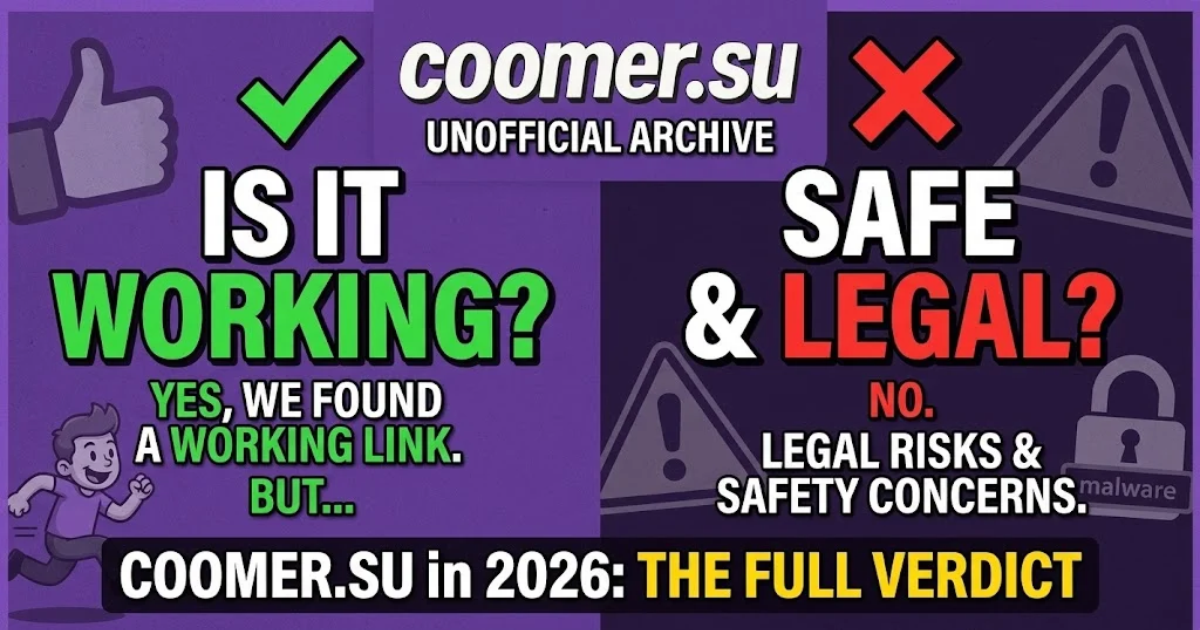
Coomer.su is a domain associated with a public archive of adult creator content. For people searching for Coomer.su in 2026, the main questions are no longer simply what the website is, but whether the old domain still works, what happened to it, whether Coomer.st is the current address, and whether the service is safe or legally reliable.
Current domain records show that coomer.su remains registered but is listed as “REGISTERED, NOT DELEGATED,” meaning the domain registration still exists while the normal website service is not currently attached to it in the usual way. The current WHOIS record lists RUCENTER-SU as the registrar, a creation date of August 25, 2022, and an expiry date of August 25, 2027.
At the same time, recent 2026 reporting identifies Coomer.st as the active successor associated with the Coomer archive. A current page at the .st domain is accessible, while independent technical and SEO reporting describes the move from .su to .st during 2025.
There is also an important security issue. Malwarebytes currently blocks coomer.su as riskware and states that the platform has been abused to share malicious files. That does not mean every page or file is malware, but it is a significant reason to avoid treating the old domain as a trusted website.
This guide explains what Coomer.su was, what happened to the domain, how Coomer.st fits into the picture, and the security, privacy, copyright, consent, and Google Search considerations users should understand.
What Is Coomer.su?
Coomer.su was associated with a public archive that collected and organized adult creator content originally connected with subscription-based platforms.
Unlike a standard creator platform, an archive of this type does not primarily operate as a direct marketplace where creators establish their own subscription pages, set prices, and receive payments from subscribers. Instead, material can be contributed or reposted by third parties.
Recent reporting describes Coomer as being associated with content originating from platforms such as OnlyFans, Fansly, and CandFans. The replacement service at Coomer.st continues the same broad archive concept.
That distinction matters because public availability does not automatically mean that the person who originally created the content authorized every subsequent copy or redistribution.
For searchers, Coomer.su is therefore best understood as the former domain of an unofficial adult-content archive, rather than as an official companion service for the major subscription platforms associated with the material.
Is Coomer.su Still Working?
The old Coomer.su domain is not currently functioning as the normal active archive address.
The latest WHOIS information shows the domain as “REGISTERED, NOT DELEGATED.” In practical terms, that means the registration still exists, but the domain is not presently delegated to an active public website in the normal way.
A direct request to the old domain also currently returns a server error, which is consistent with the domain no longer operating as the primary service.
This creates an important distinction:
A domain can still be registered without being an active website.
The fact that coomer.su has a future expiry date does not mean that the site itself is online. Current records show the registration extending to August 25, 2027, but the domain is nevertheless listed as not delegated.
Did Coomer.su Move to Coomer.st?
Current evidence strongly associates Coomer.st with the successor service.
Recent 2026 reporting states that the service moved away from the .su domain and that Coomer.st became the replacement address during 2025. Technical reporting around the migration also documents changes needed by software and download tools after the hostname changed.
The current Coomer.st website is also accessible, further supporting its role as the active address associated with the archive.
However, users should be careful with the phrase “new Coomer domain.” Search results can contain unofficial mirrors, cloned pages, copycat domains, and websites using similar branding. A domain name alone is not proof of ownership.
That is especially important when a website is associated with file downloads and adult content.
Why Did Coomer.su Stop Working?
There is no sufficiently verified public evidence establishing one definitive reason for the domain change.
Possible explanations discussed in third-party reporting include infrastructure changes, hosting problems, domain-management issues, security concerns, legal complaints, copyright enforcement, or a broader service migration. Those possibilities should not be presented as confirmed facts without primary documentation.
The most supportable conclusion is simply that Coomer.su ceased being the primary working address and the archive became associated with Coomer.st instead.
This is preferable to repeating unsupported claims that a particular government action, copyright complaint, or law-enforcement operation definitely caused the move.
What Is the Difference Between Coomer.su and Coomer.st?
The basic difference is the domain and current service status.
Coomer.su is the old domain associated with the archive and is currently listed as registered but not delegated.
Coomer.st is the domain currently associated with the successor archive. The current site describes itself as a public archiver for creator material.
The relationship appears strong enough that recent reporting treats .st as the continuation of the same general service, but users should still verify the exact domain they are visiting rather than assuming that every similarly named website is connected.
Is Coomer.su Safe?
From a cybersecurity perspective, Coomer.su should be treated as a high-risk domain.
The strongest current public warning comes directly from Malwarebytes. Its threat page says that coomer.su is blocked because it is associated with riskware and explains that the platform has been abused to share malicious files.
This distinction is important.
A riskware classification does not prove that every file on a domain is malicious, nor does it mean that every visitor will automatically get infected. Instead, it signals that a security provider has identified enough risk associated with the domain to block it.
For ordinary users, that means there is little reason to treat the old domain as a trusted source for downloads.
What Security Risks Should Users Consider?
The biggest problem is not necessarily the visible webpage itself. Risk can come from the wider ecosystem around an unofficial archive.
Untrusted downloads can include deceptive files, unexpected executables, malicious archives, or files that do not behave as their names suggest. Third-party advertisements can also create redirect chains or misleading download prompts.
Common warning signs include requests to install an unknown application, download a special browser extension, enable notifications, enter account credentials, or provide payment information before viewing something supposedly available for free.
Another risk is copycat domains.
When an old website stops working, users often search for terms such as “Coomer.su new domain” or “Coomer.su working link.” That creates an opportunity for unrelated websites to imitate the branding and target people who are looking for the replacement.
The safest approach is to avoid entering personal credentials into unfamiliar domains and never install software simply because a webpage says it is required.
Is Coomer.st Safe Just Because It Is the Current Domain?
No.
A domain change does not automatically establish that every page, file, advertisement, or download associated with the service is safe.
The same general risks can exist on any unofficial archive that relies on third-party uploads, especially where users can download media.
HTTPS alone is not enough to establish trustworthiness. A valid HTTPS connection primarily protects the connection between your browser and the website; it does not guarantee that the website owner is reputable or that every downloadable file is safe.
That is why a current working domain should still be evaluated separately from the security reputation of the old domain.
Is Coomer.su Legal in the United States?
There is no single yes-or-no answer that applies to every situation.
The legal issues can involve copyright, authorization, privacy, consent, the origin of the material, and the way the content was obtained or redistributed.
In the United States, copyright owners generally have exclusive rights that include reproducing and distributing their copyrighted works. The U.S. Copyright Office explains that copyright provides owners with the exclusive rights to reproduce and distribute protected works, subject to statutory limitations.
That means the fact that material appears online does not automatically mean that anyone else has permission to copy and redistribute it.
The legal position can become more complicated when adult creator content was originally provided through a paid subscription service and later appears on an unrelated public archive.
This article is general information, not legal advice. Laws also differ between countries and circumstances.
Does Paying for Creator Content Give Permission to Repost It?
Generally, access and ownership are two different concepts.
A subscription or purchase can give a customer permission to view content under the applicable service terms. It does not normally mean that the customer has acquired copyright ownership or unlimited redistribution rights.
For example, purchasing access does not automatically create a right to publicly repost the material, upload copies to another website, or distribute downloadable versions to other users.
The U.S. Copyright Office specifically describes reproduction and distribution as rights belonging to the copyright owner, subject to applicable limitations.
That is why an archive containing copied material may raise copyright concerns even when the original content was legitimately purchased by someone before being redistributed.
What About Creator Consent and Privacy?
Copyright is not the only issue.
Adult creator content can also involve sensitive privacy and consent questions. A person may voluntarily publish material to a particular audience or platform without agreeing to unlimited redistribution somewhere else.
The existence of an archived profile does not prove that the person consented to its presence there.
Similarly, deleting an original post or account does not guarantee that copies have disappeared from third-party archives.
For creators, this can make unauthorized reuploads especially difficult to control because copies can spread across mirrors, file-hosting services, screenshots, downloaded files, and additional websites.
Can Copyright Owners Request Content Removal?
In the United States, copyright owners can use the DMCA notice-and-takedown framework in qualifying circumstances.
The U.S. Copyright Office explains that a copyright owner may send a written takedown notification to a service provider’s designated agent when copyrighted material is allegedly being infringed. The notice must include required information identifying the work and the allegedly infringing material, along with other statements and contact information.
The existence and effectiveness of a takedown process can vary between platforms and situations. Creators may also need to address material appearing on multiple domains or services separately.
For content involving privacy or intimate-image concerns, additional legal remedies may be relevant depending on the circumstances and jurisdiction.
Is Coomer an Official OnlyFans Service?
There is no reliable evidence that Coomer is an official OnlyFans service.
The archive model is fundamentally different from a normal creator subscription platform. Recent reporting describes Coomer as an unofficial public archive of material associated with creator platforms, rather than an authorized storefront operated by those platforms.
Users should therefore not assume that a creator appearing in the archive has an official Coomer account or that the creator personally uploaded every item associated with their name.
Does Coomer Pay Creators?
Coomer is not primarily presented as a standard subscription marketplace where creators sell access directly to subscribers.
The archive model described in current reporting relies on third-party contributions rather than conventional creator subscriptions.
That means users should distinguish between paying a creator through an official platform and accessing a reposted copy somewhere else.
Using an unofficial archive may not provide the same creator support, account protections, moderation mechanisms, or direct payment relationship available through an authorized platform.
Why Are People Still Searching for Coomer.su?
The search demand around the old domain is largely understandable.
When a recognizable domain stops working, users commonly search for:
“Coomer.su”
“Coomer.su new domain”
“Is Coomer.su down?”
“Coomer.su working?”
“Coomer.st”
“Is Coomer.su safe?”
“Coomer.su legal?”
This creates a strong navigational and informational search intent around the old brand.
A current 2026 Ranktracker report indicates substantial search interest around variants such as “coomer su,” although those figures are third-party SEO estimates rather than Google first-party measurements. The same report emphasizes that traffic attributed to a Whois.com page should not be confused with traffic directly received by Coomer itself.
That distinction is important for anyone publishing SEO content on this topic.
What Does WHOIS Say About Coomer.su?
The latest WHOIS information available from Who.is shows the following core details:
| Detail | Current Information |
|---|---|
| Domain | Coomer.su |
| Created | August 25, 2022 |
| Expires | August 25, 2027 |
| Registrar | RUCENTER-SU |
| Registrant | Private Person |
| Domain status | Registered, Not Delegated |
| WHOIS data fetched | September 13, 2026 |
These records confirm that the domain registration still exists, but they do not prove that a functioning website is operating on the domain.
What Does the Current SERP Tell Us?
The current search landscape around Coomer.su is heavily focused on informational intent rather than a conventional brand homepage.
Recent indexed results prominently discuss:
- whether the old domain is still working;
- whether Coomer moved to
.st; - security and malware concerns;
- WHOIS and domain registration information;
- copyright and creator-consent issues;
- whether the site is safe to use.
That search intent suggests that a strong article should answer the user’s practical questions directly instead of simply repeating a generic description of Coomer.
Google’s own Search Essentials emphasize helpful, reliable, people-first content and warn against techniques designed primarily to manipulate rankings.
Google Search Policy: Can Adult-Related Information Rank?
Adult content has special treatment in Google Search, but Google does not simply treat every page discussing adult topics as automatically prohibited from search.
Google explains that SafeSearch is designed to filter explicit sexual content, and its systems use multiple signals to identify explicit pages. Google also recommends that sites containing sexually explicit content clearly identify that content, including through supported adult-content metadata where appropriate.
For an informational article such as this one, the goal should be to discuss the topic factually without publishing unnecessary explicit material.
Google also notes that pages identified as explicit may not qualify for certain search features, including some rich-result or featured-snippet experiences.
What Google SEO Practices Should Be Avoided?
This topic can attract strong search demand, which makes keyword stuffing especially tempting.
Google explicitly defines keyword stuffing as excessive or unnatural repetition of keywords intended to manipulate rankings. Google also warns against scaled content abuse, scraping, doorway pages, and other techniques that create pages primarily for search manipulation instead of user value.
For a Coomer.su article, that means the keyword should appear naturally in the title, introduction, headings, and relevant body copy rather than being repeated in every paragraph.
The content should also add original value through current domain status, security context, legal considerations, and clear distinctions between Coomer.su and Coomer.st.
Is Coomer.su a Scam?
There is not enough evidence to describe the entire service simply as a scam.
A more accurate description is that the old domain is currently inactive or non-delegated, is associated with an unofficial adult-content archive, and carries a documented security warning from Malwarebytes.
Users should be especially suspicious of third-party websites claiming to be official Coomer mirrors if those sites demand money, credentials, cryptocurrency, browser extensions, or application downloads.
What Should Users Avoid?
Users should avoid entering passwords from other services into unfamiliar websites.
They should also avoid downloading unknown executable files, installing browser extensions from random prompts, disabling security software to access a page, or providing financial information to a site simply because it claims to be a replacement domain.
A VPN may improve network privacy in some situations, but it does not verify whether a downloaded file is safe, whether content was legally redistributed, or whether a website is genuine.
What Is the Safest Way to Access Creator Content?
The lowest-risk approach is to use the creator’s verified official account or authorized platform.
Official platforms generally provide clearer information about subscriptions, creator identity, payment, account access, reporting, and content ownership than an unofficial archive.
For users who simply want to support a creator or access their work, going through the creator’s verified channel also reduces the risk of accidentally visiting an impersonation site or downloading a malicious file from an untrusted mirror.
Frequently Asked Questions
What is Coomer.su?
Coomer.su was a public archive associated with adult creator content originating from subscription-based platforms. It was not the same type of service as an official creator subscription marketplace.
Is Coomer.su still working?
The old domain is currently not functioning as the normal active service and its WHOIS status is listed as “REGISTERED, NOT DELEGATED.”
What happened to Coomer.su?
The archive became associated with the .st domain during 2025. The precise reason for the domain transition has not been definitively documented in reliable public sources.
What is Coomer.st?
Coomer.st is the current domain associated with the successor archive and continues the general public-archiver concept linked to Coomer.
Is Coomer.su safe?
The old domain should be treated cautiously. Malwarebytes currently blocks it as riskware and says the platform has been abused to share malicious files.
Is Coomer legal in the USA?
The answer depends on the specific content, authorization, rights involved, and circumstances. Unauthorised reproduction or distribution can raise copyright concerns under U.S. law.
Does subscribing to a creator give permission to repost content?
Access to content does not generally transfer copyright ownership or automatically create permission to redistribute the material publicly. The exact terms and legal circumstances still matter.
Is Coomer an official OnlyFans website?
There is no evidence establishing Coomer as an official OnlyFans service. Current reporting treats it as an unofficial archive associated with material from creator platforms.
Why does Google show Coomer.su results?
Users may search the old domain to determine whether it is down, find information about the domain, identify a replacement, or research safety and legal concerns. Current search-oriented coverage reflects these informational and navigational intents.
Can adult-topic pages appear in Google?
Yes, but Google uses systems such as SafeSearch to filter explicit material for users who enable filtering or where applicable. Google also provides specific guidance for websites containing explicit content.
Can creators request copyrighted material to be removed?
In qualifying U.S. situations, copyright owners can send a DMCA takedown notification to an online service provider’s designated agent.
Should I trust a Coomer mirror?
Do not assume that a similarly named domain is official. Check the exact domain, avoid sites requesting credentials or unknown software, and be particularly cautious with downloads.
Final Takeaway
Coomer.su is best understood as the former domain associated with an unofficial public archive of adult creator content. Current WHOIS data shows that the domain remains registered but is not delegated, and the old address is not functioning as the main service.
Current reporting and the live .st site associate Coomer.st with the successor archive.
The most important practical issue is security. Malwarebytes currently blocks Coomer.su as riskware because the platform has been abused to share malicious files. That does not prove that every piece of content is malicious, but it is a strong reason not to trust the old domain with downloads or personal credentials.
There are also legal and privacy considerations. Public availability does not automatically establish permission to reproduce or redistribute copyrighted creator material, and adult content can create additional consent and privacy concerns. U.S. copyright law gives rights holders exclusive rights concerning reproduction and distribution, subject to statutory limitations.
For searchers in the United States, the most useful way to approach Coomer.su in 2026 is therefore to distinguish between three separate questions: Is the old domain working? Is the newer domain genuinely associated with the service? And is the content or downloading activity safe and authorized?