

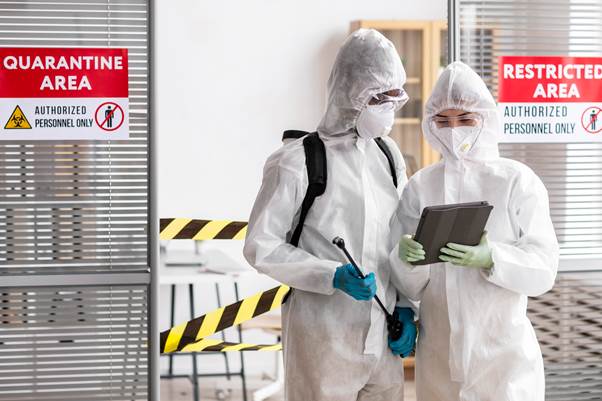
Is your property hiding a silent threat? Older buildings often harbour hidden asbestos. Disturbing these materials releases invisible, toxic fibres into your air, creating a legal and health nightmare. Without professional monitoring, you risk non-compliance and exposing occupants to permanent respiratory damage without even knowing it. Know what a professional Occupational Hygienist does to conduct effective air monitoring.
Key Takeaways
- Mandatory Safety Checks: Air monitoring is legally required for friable asbestos removal and highly recommended for bonded projects exceeding 10m2
- Professional Expertise Required: Only qualified hygienists using NATA-accredited labs can validly certify that fibre levels are safe for building re-entry
- Critical Safety Thresholds: Areas are deemed safe only when fibre concentrations fall below 0.01 f/mL, ensuring no breathable risk remains
CSIRO Australia reports that most buildings built before the 1980s (especially in the 1970s) are highly likely to contain asbestos. Those constructed after 1990 are unlikely to contain asbestos. ACMs (Asbestos-Containing Materials) are usually found in roofing, flooring, or walls, and if disturbed, the invisible fibres become a real danger. For that, you would need professional air quality monitoring services.
But most property owners and PCBUs (Person Conducting a Business or Undertaking) do not know what asbestos air monitoring is and what it involves, or whether the person doing it is qualified. This blog will explain how occupational hygienists conduct air monitoring and what the results mean for your property.
What is Asbestos Air Monitoring and Why Is It Needed?
Asbestos air monitoring is the process of capturing air samples inside your property to measure the concentration of airborne asbestos fibres. Professionally conducted assessments by occupational hygienists/independent licensed asbestos assessors ensure that the airborne asbestos, ACMs, or asbestos-containing dust (ACD) is in the permitted range or below.
It is legally required in Australia because:
- Assessment and monitoring are mandatory for all Class A (friable) asbestos removal
- Assessment and monitoring are recommended for Class B (non-friable/bonded) asbestos removal when the asbestos amount is more than 10m2
You will also need it if you, as a PCBU or property owner, are uncertain whether the exposure standard is more than the accepted limit.
What are the Different Types of Asbestos Air Monitoring?
Asbestos air monitoring is not just a single assessment. Overall, there are three major methods, each serving a different purpose at different stages of asbestos removal. The following table presents a comparison for easy understanding.
| Monitoring Type | When It’s Done | Purpose | Who Collects Samples |
| Background/Pre-work | Before any removal begins | Establishes baseline asbestos fibre levels; determines if the activity can be done safely, and the precautions to take, used for comparison during and after work | Occupational hygienist or licensed asbestos assessor |
| Control Monitoring | During removal work | Measures the effectiveness of containment and control measures; static/positional sampling 1–2 m above the floor | Occupational hygienist or licensed asbestos assessor |
| Exposure Monitoring | During removal work | Measures fibres in a worker’s breathing zone via a lapel-mounted pump; compared against the national exposure standard of 0.1 f/mL (8-hr TWA)* | Occupational hygienist |
| Clearance Monitoring | After removal and decontamination, before enclosures are dismantled | Confirms area is safe for reoccupation; must be below 0.01 f/mL | Independent licensed asbestos assessor (mandatory for Class A) |
*TWA: Time-Weighted Average
Table 1: Types of Asbestos Air Monitoring
In some cases, primary analytical methods like “Phase Contrast Microscopy (PCM)” or “Transmission Electron Microscopy (TEM)” are also used to further test the samples.
How Occupational Hygienists Conduct Air Monitoring
Here’s how occupational hygienists in Sydney, Brisbane, Perth, and other areas conduct air monitoring:
1. Site Assessment
They review the asbestos register, scope of works, and site condition. Then the hygienist determines the number and placement of static and personal sampling locations according to airflow, human traffic, and work methodology.
2. Equipment Setup
They set up calibrated air pumps that draw air through a 0.8/0.45 µm (micrometre) membrane filter cassette at 0.5 to 16 L/min (maximum 2.5 L/min for personal tests). L/min is the air flow rate needed for assessments. Personal pumps are clipped to workers’ lapels within the breathing zone.
3. Sampling
The pumps run for a minimum of 4 hours (usually a full shift) to receive statistically valid results. The clearance samples are run for a long time, which is sufficient to detect fibres at the 0.01 f/mL threshold.
4. Laboratory Analysis
The filters are sent to a NATA-accredited laboratory, where PCM, as a standard method, is applied along with TEM, which is used when precise fibre identification is legally required.
5. Reporting
Finally, a written report that documents sampling locations, flow rates, calibration data, results, and comparison against exposure standards. These records should be kept for 40 years as per the Safe Work Australia requirements.
Understanding Your Property’s Monitoring Results
When you receive an air monitoring report, two numbers matter the most. The standard threshold and the numbers in your results show against the threshold.
| Standard | Limit | What It Means for You | Regulatory Source |
| Workplace Exposure Standard (TWA) | 0.1 f/mL (8-hr average) | The maximum concentration workers can be exposed to during removal, above which work must be stopped and controls upgraded | Safe Work Australia; WHS Regulations |
| Clearance Level | <0.01 f/mL | Area passes clearance and is safe for occupants to re-enter without PPE, and enclosures can be dismantled | Safe Work Australia Code of Practice: How to Safely Remove Asbestos (2021) |
| Notification Trigger | ≥ 0.02 f/mL during friable removal
(same for all states) |
A licensed removalist should immediately notify the state workplace safety management bodies | WorkSafe Queensland; SafeWork NSW; Must notify Comcare under the Work Health and Safety Regulations 2011 |
| NATA Lab Requirement | All analysis | Results from non-NATA-accredited labs are not usually accepted by regulators or insurers | National Association of Testing Authorities (NATA) or NATA-accredited labs |
Table 2: Asbestos Air Monitoring Thresholds in Australia
A result of “<0.01 f/mL” or below the detection limit is the best possible outcome. Because it means that no countable fibres were found, and the air is safe for the residents of the building. A failed clearance result means that re-cleaning and re-assessment are needed, but it might not be a serious hazard.
Contact Remediation Services Today for Air Monitoring!
Conducting an effective asbestos air monitoring requires qualified, independent professionals and NATA-accredited laboratory analysis. If you own a property built before 1990 in Perth, Sydney, or Brisbane, contact a reputed independent occupational hygienist in Sydney, Brisbane, or Perth for compliant asbestos air monitoring. Know whether the air inside your property is safe or not!
 Blitz
Blitz