

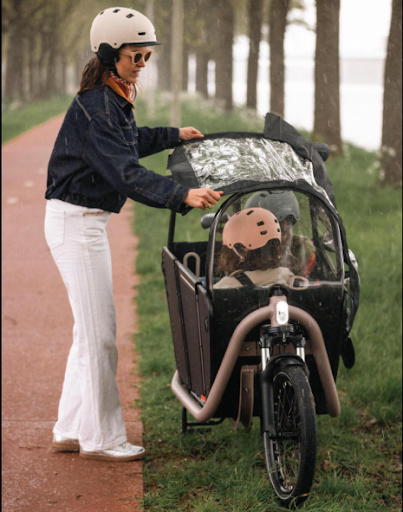
The first genuinely wet school run I did on a cargo bike was in October, about six weeks after I started. It had been a dry September, and I had been quietly congratulating myself on how well the whole cargo bike thing was going. Then came a Wednesday morning with sideways rain and a wind that made the box bike feel like a sail.
I made it to school. My daughter, tucked under the rain cover, arrived completely dry and thought the whole thing was excellent. I arrived soaked from the shoulders up because I had not thought properly about my own waterproofing. But the bike performed. The brakes worked. The tires held grip. The motor kept pushing without any drama.
That morning taught me more about weather-ready cargo bike design than any review I had read. Here is what I know now that I wish I had known then.
Why Weather Resistance Is a Design Question, Not an Accessory Question
A lot of families approach wet-weather riding as an accessory problem. Buy a rain cover, buy some fenders, sort the lighting, and you’re done. Weather resistance treated this way is always slightly incomplete. You end up with gaps, things that do not quite fit together, and a rain cover that lets water in at the sides because it was designed for a different box shape.
The cargo bikes that handle bad weather best are the ones where weather resistance was designed in from the start. Sealed motor and battery housings with proper IP ratings. Frame geometry that channels water away from electrical components. Integrated fender mounts with enough clearance for mud and debris. Rain covers designed specifically for that model’s cargo box rather than generic covers adapted to fit.
When you are comparing bikes, ask specifically about weather-related engineering rather than just checking whether accessories are available. Available is not the same as designed for.
What IP Ratings Actually Mean for Real Riding
Most quality family cargo e-bikes list IP ratings for the motor, battery, and display unit. IP stands for Ingress Protection. The two numbers tell you the level of protection against solid particles and water, respectively.
For family cargo bikes used in all weather conditions, you want a minimum of IP65 on motor and battery components. IP65 means fully dust-tight and protected against water jets from any direction. That covers riding through heavy rain, puddle splash, and the occasional accidental hose-down when cleaning the bike.
IP54, which appears on some lower-specification bikes, means limited dust protection and splash resistance only. It handles light rain adequately but is not what you want on a bike that will be ridden regularly in proper wet conditions year-round.
The display unit is worth checking separately. Some bikes have well-sealed motors and batteries but displays that are only splash-resistant. A display that fogs up inside or develops moisture problems over winter is a real nuisance and sometimes an expensive one if it needs replacing.
Tyres for Wet Tarmac With a Heavy Load
Tyre choice on a heavy cargo bike in wet conditions is not something to leave to chance or to whatever came stock on the bike.
Wide tires with a relatively open tread pattern shed water more effectively than narrow slicks. On a 200-kilogram loaded cargo bike, the tire contact patch carries significant pressure, and a tire that aquaplanes or loses lateral grip on wet tarmac at even moderate speeds is a genuine safety problem.
Look for tires in the 2.0 to 2.4 inch range with a compound that remains pliable in cold temperatures. Rubber hardens in cold weather and loses grip. Some cheaper cargo bike tires use a single compound that works adequately in summer but becomes noticeably less grippy below about 7 degrees Celsius. A quality all-season tire with a softer compound makes wet winter riding meaningfully more secure.
Puncture resistance also matters more on a cargo bike than on a lighter bicycle. A puncture on a standard bike is inconvenient. A puncture on a loaded family cargo bike in the rain with children on board is a significant problem. Tires with reinforced puncture protection layers are worth the additional cost on a daily-use cargo bike.
Tyre pressure matters more than people realize.
Running slightly lower tire pressure in wet conditions increases the contact patch and improves grip. On a heavy cargo bike this effect is meaningful. Check the tire’s recommended pressure range and run toward the lower end of that range in wet weather. Not below the minimum, but comfortably below the maximum that some riders default to year-round.
Keeping Children Dry: Rain Covers That Actually Work
For front-load box bikes, the rain cover is probably the single most important weather accessory. A well-designed cover keeps the cargo area genuinely dry in sustained heavy rain, keeps wind off young passengers, and reduces wind noise enough that you can still hear children and they can hear you.
The difference between a good rain cover and a poor one is significant and not always obvious from photographs. Good covers have proper tensioning systems that prevent flapping in wind. They have sealed seams rather than just overlapping fabric. The clear panels are optically clear rather than milky, so you maintain good visual contact with children inside. Entry and exit points close securely without requiring two free hands to operate.
Poor covers flap in wind and create noise that distracts children and riders. They let water in at the edges during sustained rain. The clear panels scratch and cloud within a season. Fitting and removing them takes three times as long as it should.
Worth checking before buying a rain cover: can you open and close the main entry point with one hand while the bike is on its kickstand? You will be doing this at the school gate in the rain, probably with a school bag over one shoulder. A cover that requires both hands and full attention to operate becomes a daily annoyance that gradually makes you less willing to ride in wet weather at all.
Wind: The Weather Factor That Gets Underestimated
Rain gets all the attention when people talk about weather-ready cargo bikes. Wind deserves more of it.
A front-load box bike with a large rain cover fitted presents a significant cross-section to a side wind. In strong gusting conditions, this creates a handling challenge that is quite different from anything you experience on a standard bicycle. The bike wants to be pushed sideways. You are correct with steering input. The correction can feel sudden if you are not expecting it.
Experienced cargo bike riders learn to read gusty conditions and adjust speed and lane positioning accordingly. They also learn which routes have exposed sections where side winds are consistently stronger and plan for those sections specifically. This is not a reason to avoid riding in wind. It is a reason to build experience gradually and to choose a bike with stable handling characteristics rather than one that is already marginal at low speeds in calm conditions.
Heavier bikes, somewhat counterintuitively, often handle wind better than lighter ones because their mass resists lateral deflection. A well-loaded cargo bike with a low center of gravity can feel remarkably planted in side winds that would make a lighter, unloaded bike feel nervous.
Battery Performance in Cold and Wet Conditions
Lithium batteries lose capacity in cold temperatures. The relationship is not linear and varies by battery chemistry, but a rough guide is that a battery operating at 0 degrees Celsius delivers somewhere between 70 and 80 percent of the capacity it delivers at 20 degrees. Below freezing, the reduction becomes more pronounced.
For daily winter school runs this means two practical things. First, charge the battery indoors the night before rather than leaving it on the bike in a cold garage. A warm battery starts with full capacity and loses less to temperature during the ride. Second, factor the cold-weather reduction into your range planning. A route that uses 40 percent of your battery in summer might use 55 percent in January.
Some cargo bike batteries have integrated thermal management that helps maintain operating temperature in cold conditions. This feature is worth specifically checking for if you ride regularly in temperatures below about 5 degrees Celsius.
Building a Real All-Weather Kit
The cargo bike handles the weather. You still need to handle your share of it.
Waterproof overpants and a proper cycling rain jacket make the difference between arriving at school damp and uncomfortable and arriving dry enough to go straight to work afterward. The jacket matters more than anything else because most riding-position rain exposure hits the shoulders and upper body first.
Waterproof gloves extend riding comfort in cold, wet conditions considerably. Cold hands with reduced grip sensitivity are a safety issue on a loaded cargo bike, not just a comfort problem. Overshoe covers for cycling shoes keep feet dry and warm and cost relatively little compared to the misery of wet feet on a 20-minute ride in November.
Families who build their all-weather kit properly in September, before the weather turns, are the ones who ride through winter without interruption. Families who try to improvise when the first bad week arrives often end up driving instead and gradually lose the cargo bike habit.
What Makes a Cargo Bike Genuinely All-Weather Ready
All of the above comes together in bikes that were designed with year-round family use as a genuine engineering requirement rather than a marketing claim. The full range of HOVSCO Family E-Bikes reflects this approach: purpose-built family designs with sealed electrical systems, stable handling under load, and accessory ecosystems that include weather protection designed to work with the specific geometry of each model rather than generic solutions bolted on afterward.
For a broader picture of how weather adaptability, safety features, and urban riding performance combine in the best current cargo bike options, the detailed guide to Urban Family Cargo Bikes covers all of these factors together in the context of real city riding conditions rather than ideal test scenarios.
The families who ride cargo bikes in all weather are not a special category of unusually hardy cyclists. They are mostly ordinary parents who bought bikes that made all-weather riding easy enough to do without thinking too hard about it. The bike does most of the work. You just need to show up dressed for the conditions.